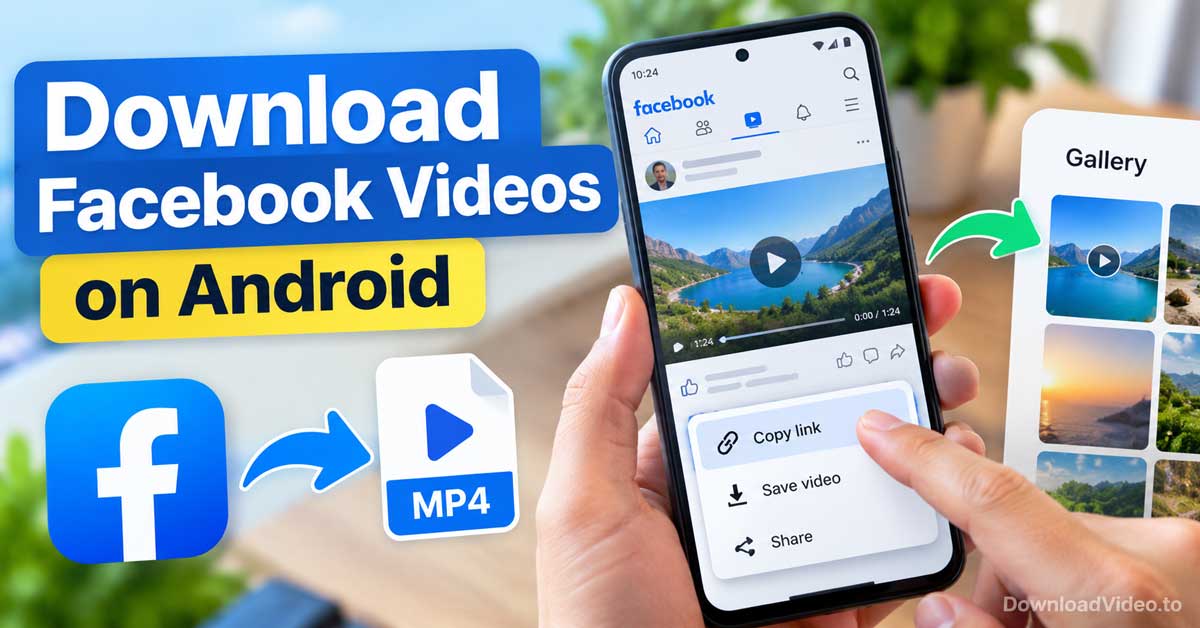
To download Facebook videos on Android, copy the video link in the Facebook app, paste it into a Facebook video downloader in Chrome, pick a quality and tap the download button. The MP4 saves to the Download folder of your phone.
Specifically, the whole job runs inside the browser that already sits on your phone. DownloadVideo.to does not ask for your Facebook login, does not need an app from Google Play and does not store the videos or links you paste. It is free, and there is no daily cap on how many videos you save.
Once the file is on your phone, you can see it in your gallery. Google Photos lists it in the Download device folder under Collections, and most gallery apps that come with Android phones show the same folder as an album, so the clip plays next to the videos you recorded yourself.
Below, the guide walks through each step in the order you will do it, then covers where the file lands, how to open it in Gallery or Google Photos, which quality to tap and which kinds of Facebook videos work on an Android phone.
How do you download Facebook videos on Android?
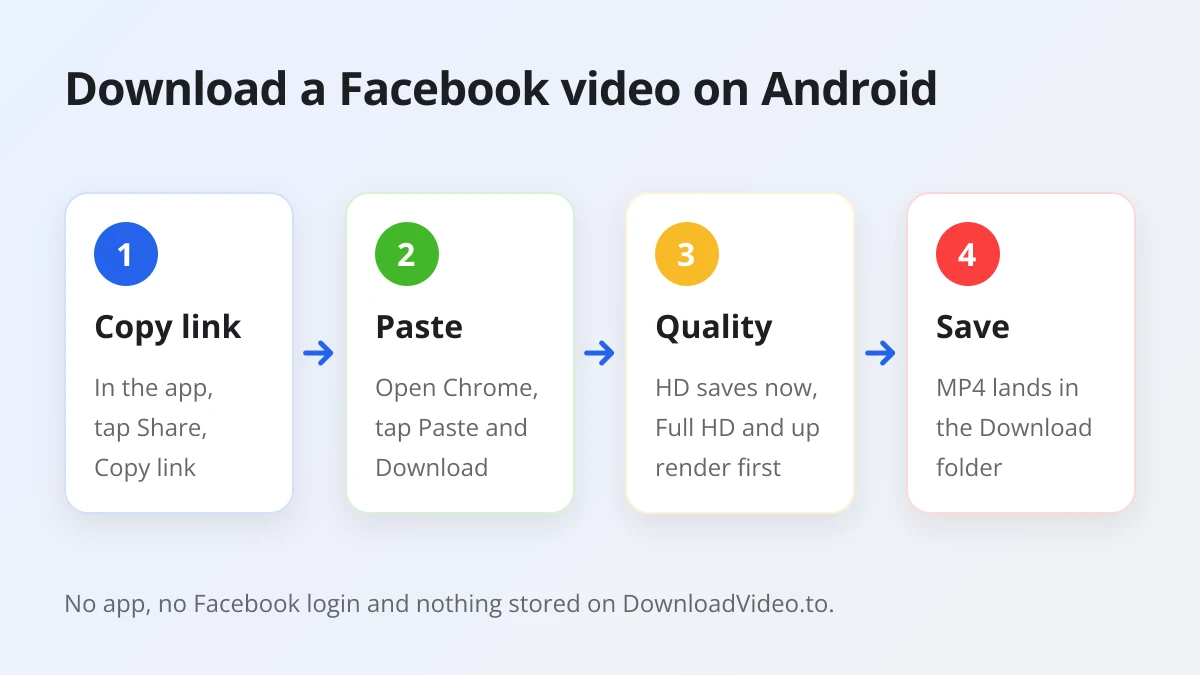
You download Facebook videos on Android in 4 steps: copy the video link, paste it on DownloadVideo.to in Chrome, choose a quality, then let Chrome save the MP4 to your Download folder.
To begin, the picture below sums up those 4 steps. Each one takes a few taps, and a short clip is usually on your phone within a minute on a normal connection.
The method works because a downloader only needs the address of the video. DownloadVideo.to reads the link you paste, finds the video files that Facebook already serves for that post and lists every quality the original upload has. Your phone then receives a normal MP4 file, the same way it receives a PDF or a photo from any website.
Step 1: Copy the video link in the Facebook app
You copy the link by opening the video in the Facebook app, tapping Share and choosing Copy link. The address is now on your Android clipboard, ready to paste.
In practice, the Share button sits under a regular post and on the side of a reel. If the share menu opens with a row of contacts and apps first, look along the options until Copy link appears. Links from facebook.com, fb.watch and fb.com all work, so it does not matter which form Facebook gives you.
If you watch Facebook in Chrome instead of the app, open the video so it plays on its own page, tap the address bar and copy the full address. Avoid copying a caption or a line of text together with the link. A clean address is the single most important part of a successful download.
Step 2: Paste the link on DownloadVideo.to in Chrome
You paste the link by opening DownloadVideo.to in Chrome, tapping Paste inside the box at the top of the page and then tapping Download Video. The available qualities appear a few seconds later.
Next, check what the box shows before you continue. Its placeholder reads "Paste a Facebook video link", and once the link is in place a Clear button lets you empty the box if you pasted the wrong address. Chrome may show a small prompt asking to allow access to the clipboard; allow it, or press and hold inside the box and choose Paste from the menu.
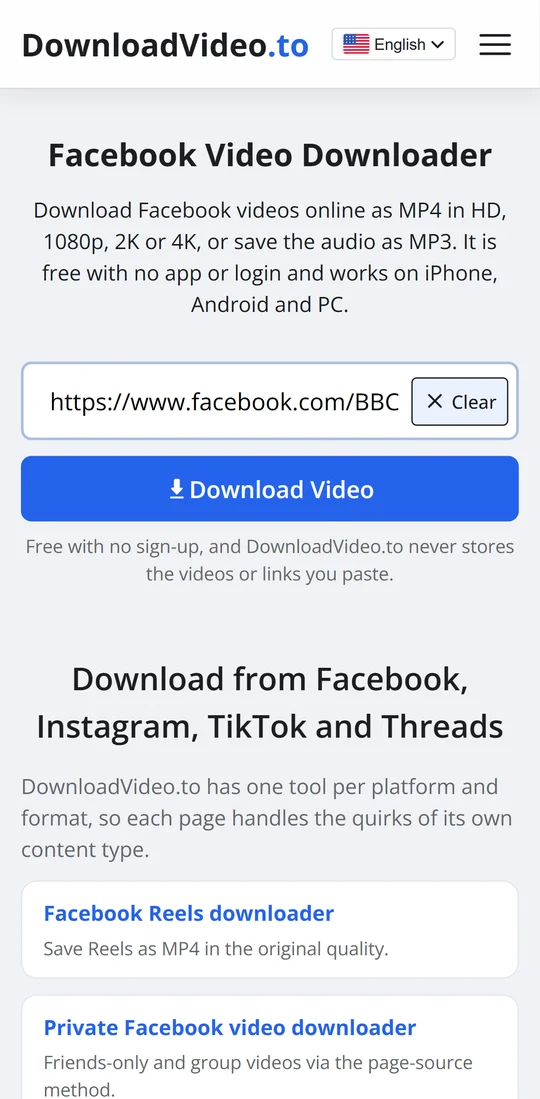
Under the button, a short line reminds you that the tool is free with no sign-up and never stores the videos or links you paste. Nothing else is needed on this page: no account, no extension and no permission request.
Step 3: Choose a quality from the result list
You choose a quality by tapping the button in its row: Download now for Standard quality and High quality, or Render and download for Best quality, 2K quality and 4K quality.
To clarify, each row shows a badge with the resolution, a plain label such as High quality and the file format. The rows you see always depend on the original upload. A clip filmed in 4K can show 2K and 4K rows, while an older or smaller upload may stop at HD.
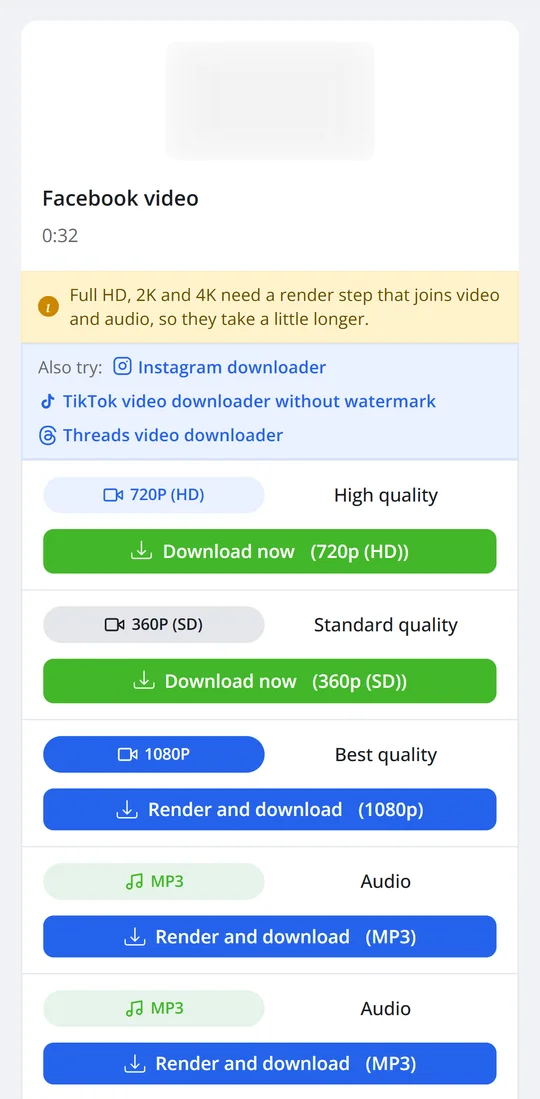
Full HD, 2K and 4K need a render step. Facebook serves those qualities as separate video and audio streams, so the tool joins them into one MP4 before saving. When you tap Render and download, a Processing bar with a percentage replaces the button, and the file starts saving when it is ready. Standard and High quality skip this step and save straight away.
Step 4: Let Chrome finish the download
You finish the download by keeping Chrome open until the transfer ends. Chrome then shows the file as complete, and the MP4 sits in your phone's Download folder.
While it runs, Chrome shows the progress in a download notification or at the bottom of the screen, depending on your version. Tapping the finished download opens the video in your default player straight away. If you switch to another app too early on a slow connection, check Chrome's Downloads list afterwards to confirm the file completed.
Download links also expire after a short while. If a button stops working because you waited too long, paste the Facebook link again and choose the quality once more.
Can you download Facebook videos on Android without an app?
Yes, you can download Facebook videos on Android without an app, because Chrome can already save files, the Files app already shows them, and a browser downloader needs nothing more than the video link.
In other words, every part of the job is covered by software that ships with Android. Here are the main reasons the browser route suits most people:
- Nothing to install or update. Chrome is on almost every Android phone, so there is no new app asking for access to your storage, contacts or Facebook account.
- No Facebook login. DownloadVideo.to reads public videos from the link alone, so you never type your Facebook password into a third party page.
- Nothing stored. Files stream from Facebook to your phone, and the site keeps no copy of the video and no history of the links you paste.
- Free with no limit. There is no fee, no account and no daily cap on downloads.
The picture below compares the browser method with the two other options people usually try.
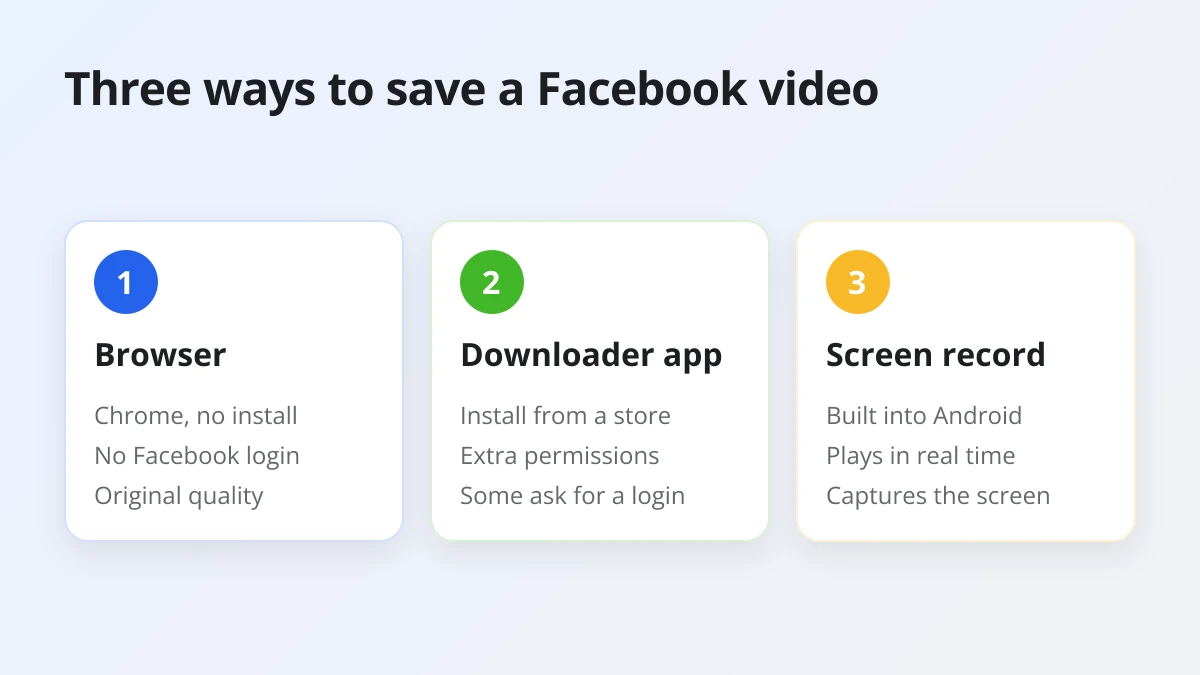
Downloader apps from app stores can do the same job, but each one is another program with its own permissions, ads and update cycle. Some ask you to log in to Facebook inside the app, which hands your session to a developer you do not know. A web page you open only when you need it avoids that trade off entirely.
Screen recording is the other app free option, since many Android phones include a recorder in Quick Settings. However, a recording captures everything on screen, including notifications and buttons, plays in real time and usually looks softer than the original. Saving the original file from the link is faster and keeps the quality the uploader chose.
Using the browser also keeps your phone tidy. Each download is one MP4 file that you can open, move or delete like any other file, and nothing keeps running in the background once you close the tab. If you save a video only now and then, this is far lighter than a dedicated app on your home screen.
Where do downloaded Facebook videos go on Android?
Downloaded Facebook videos go to the Download folder in your phone's internal storage. You can reach them from Chrome's Downloads list or from the Files app, and gallery apps can read the same folder.
To find the file quickly, the path depends on where you start. The picture below shows the three places the MP4 appears.
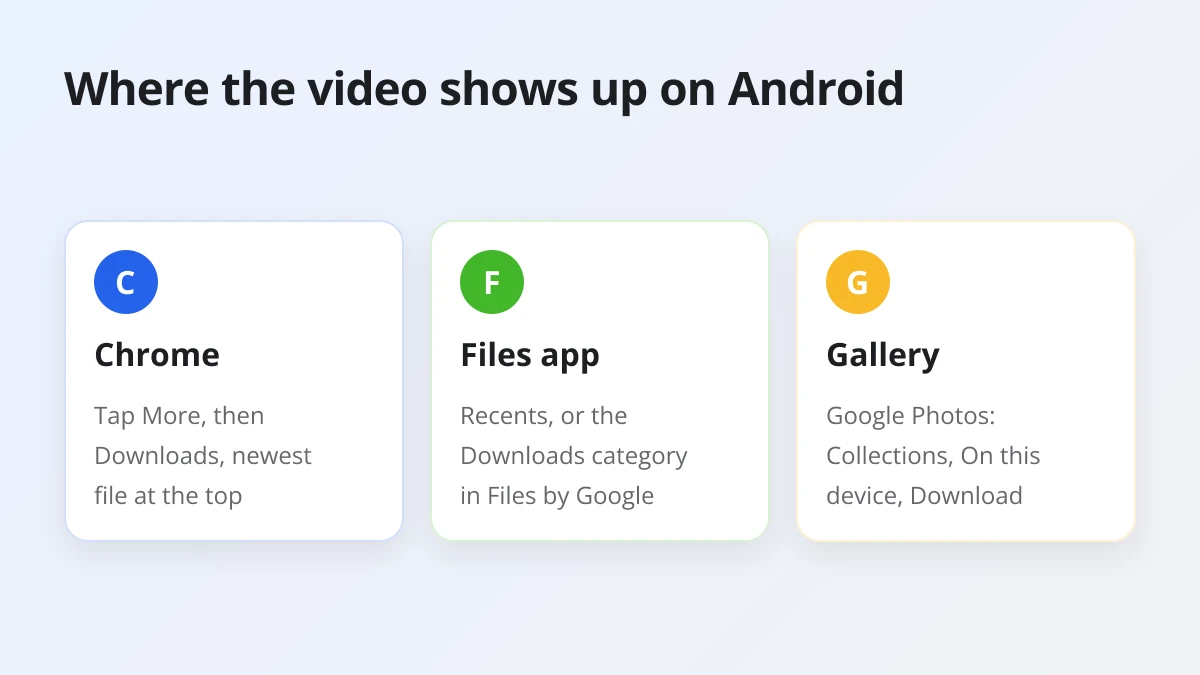
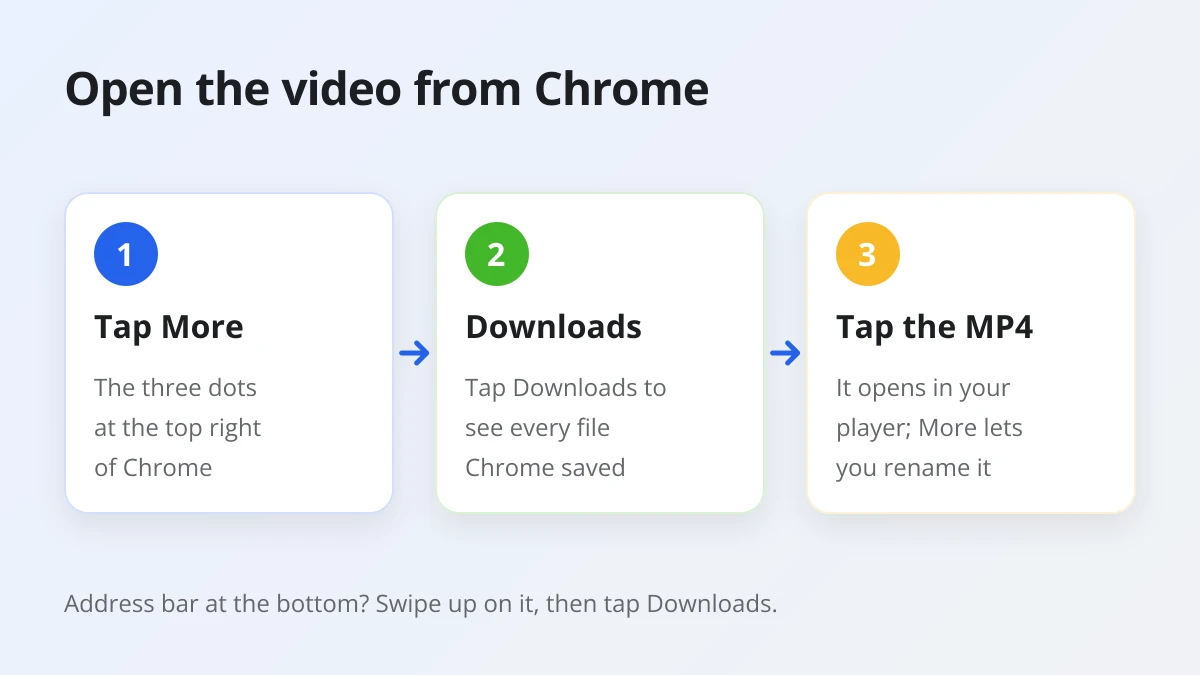
In Chrome's Downloads list
Chrome keeps a list of every file it saved. Tap More (the three dots at the top right), then tap Downloads, and the Facebook video sits at the top of the list.
According to Google Chrome Help, if your address bar is at the bottom of the screen, you swipe up on the address bar and tap Downloads instead. From that list you can open the video, and the More menu next to each file lets you share, rename or delete it. Renaming is handy when you save several clips, because the default file name does not describe what the video shows.
In the Files app
The Files app shows the same MP4 outside Chrome. Open Files by Google, look under Recents for the newest download, or tap the Downloads category to see every file you saved.
Some phones use a file manager made by the phone maker instead, and Google notes that steps may vary by device. In those apps, look for a Downloads or Download entry, or open internal storage and then the Download folder. From the Files app you can move the video to another folder, copy it to an SD card if your phone has one, or share it to a messaging app without opening Facebook again.
Can you save Facebook videos to your gallery or Google Photos?
Yes, you can save videos from Facebook to Photos and to your gallery, because the download is a standard MP4, gallery apps read the Download folder, and no conversion step is needed before the clip plays.
That is why the answer to "Can you save videos from Facebook to photos?" depends less on Facebook and more on where your gallery app looks. Facebook's own Save option only bookmarks a video inside Facebook, in your Saved list, so nothing reaches your phone that way. A real file in the Download folder is what makes the video show up in a gallery. The picture below shows the usual path in Google Photos.
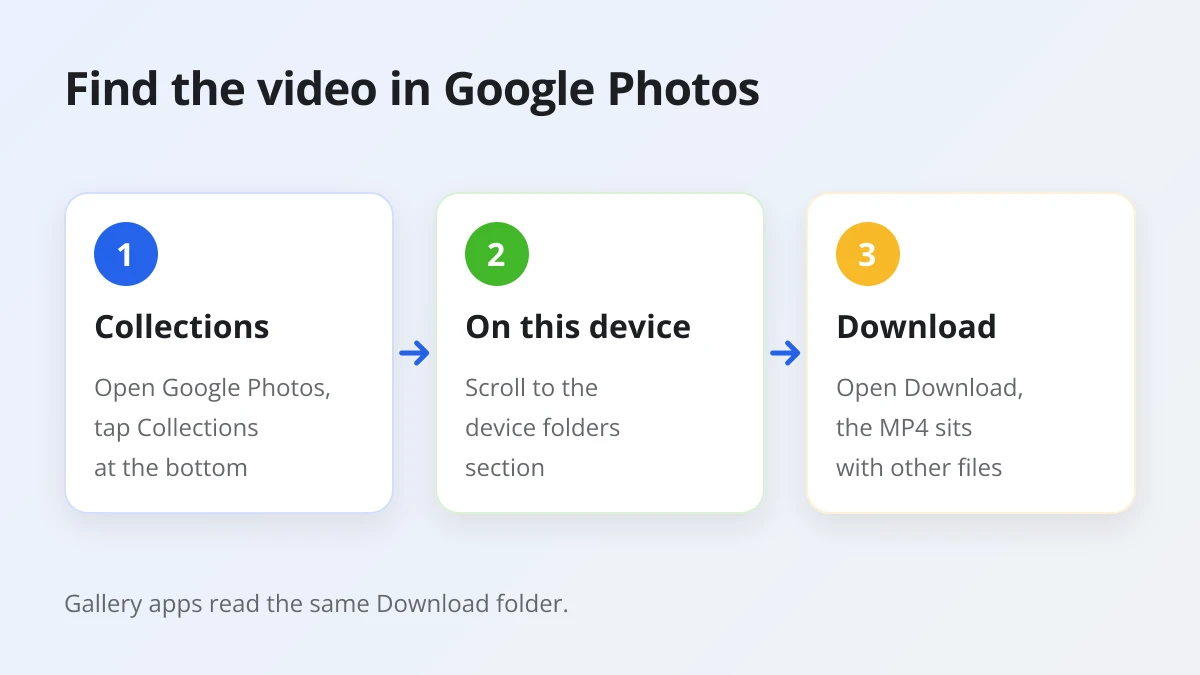
Find the video in Google Photos
In Google Photos, tap Collections at the bottom, then On this device, and open the Download folder. The Facebook video sits there with your other downloaded files.
Google explains this layout in its help page on finding items from other apps and devices: pictures and videos that other apps save are grouped by device folder. Depending on your settings, the clip may also appear in the main Photos view, and you can hide device folders from that view if you prefer a clean timeline.
Backup is separate from viewing. If you want the video stored in your Google account as well, open Photos settings, tap Backup, then Back up device folders and turn on the Download folder. Leave it off if you only want the clip on the phone, since large 1080p or 4K files use cloud storage quickly.
Find the video in your phone's Gallery app
Gallery apps made by phone makers usually show the Download folder as its own album. Open your Gallery app, switch to the Albums view and look for an album named Download or Downloads.
Names and menus differ between brands, so treat this as a general route rather than an exact path. If the album is missing, the video can still be opened from the Files app. Some gallery apps hide folders that are not camera folders until you allow them in the app settings, so check the album list or the options menu for hidden albums.
To keep the clip with your camera videos, open it in the Files app and move it to another folder, such as the folder your camera uses or a new folder named Facebook. The gallery then lists it under that album instead. Moving the file does not change its quality, because it stays the same MP4.
Which video quality should you choose on Android?
High quality (HD) is the best default on Android because it saves instantly and looks sharp on a phone screen, while Best quality, 2K and 4K suit a TV or tablet and MP3 suits sound only.
To decide quickly, the table below compares the options in the result list, the button each one uses and the situation each fits best on a phone.
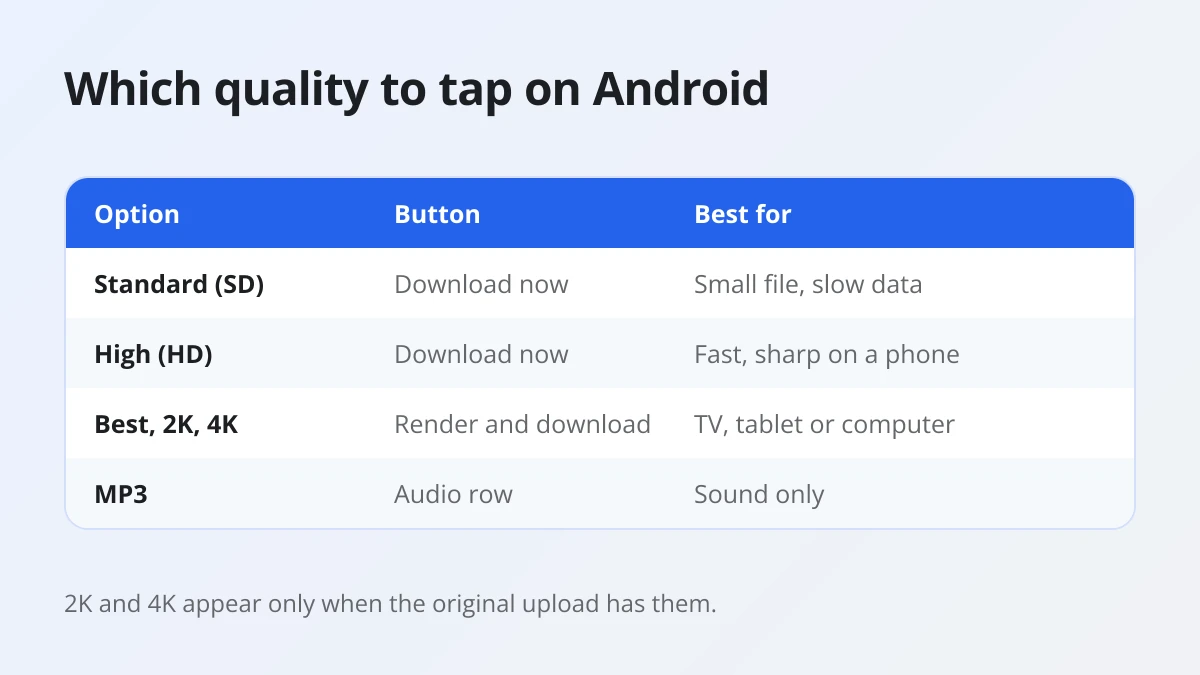
Here is the same comparison in text form, using the labels shown on DownloadVideo.to:
| Option | Button | Best for |
|---|---|---|
| Standard quality (SD) | Download now | Smallest file, slow data or little free storage |
| High quality (HD) | Download now | Fast save, sharp on a phone screen |
| Best quality (Full HD), 2K, 4K | Render and download | Sharpest copy for a TV, tablet or computer |
| MP3 | Audio row | Sound only, such as music or a talk |
Beyond picture detail, file size is the main trade off. A higher quality means a bigger file, more space in the Download folder and a longer transfer on mobile data, so connect to Wi-Fi before you save a long 4K video. 2K and 4K rows appear only when the person who posted the video uploaded it in that quality, so a missing 4K row is not an error.
For sharing, a smaller file is often the better choice. Messaging apps compress large videos or refuse them, and an HD file is usually easier to send than a Full HD one. If you plan to cast the video to a TV or edit it later, choose the highest row available instead.
Which Facebook videos can you download on Android?
There are 3 groups of Facebook videos on Android: public videos that work with the link method, private and group videos your account can watch, and videos you cannot reach because your account cannot play them.
To be clear, the deciding factor is who can watch the video, not which phone you use. The picture below shows the three groups.
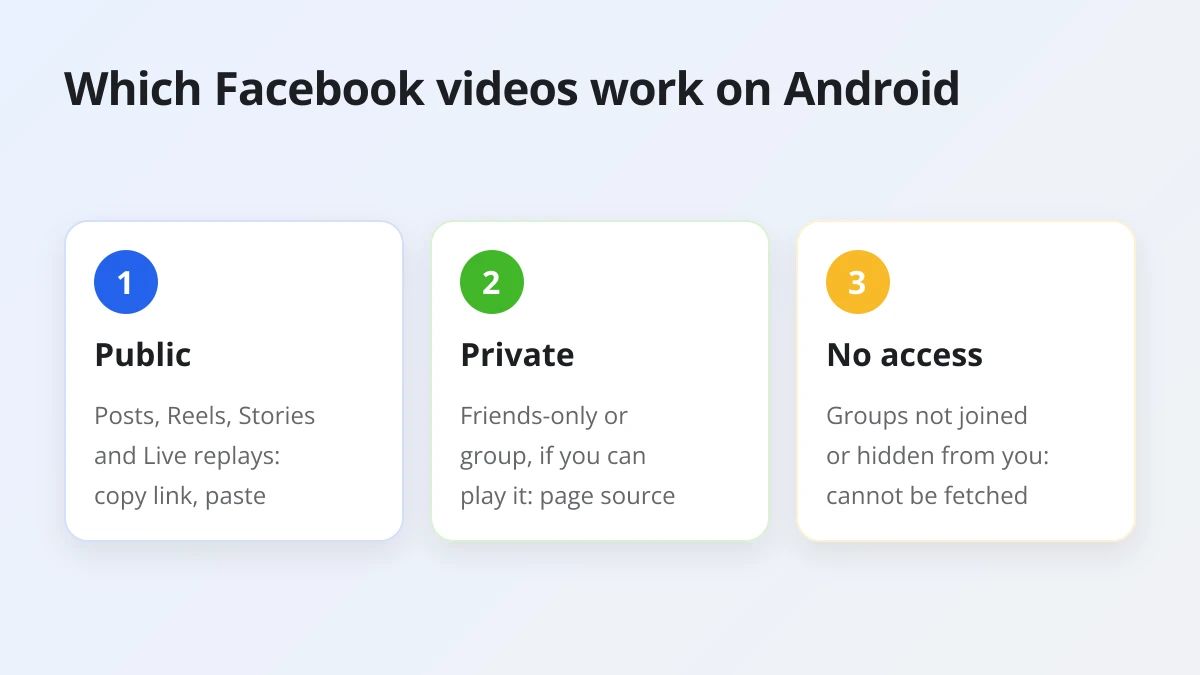
- Public videos. Regular posts, Reels, Stories and finished Live broadcasts from public profiles, Pages and public groups all work with the 4 steps above. Reels also have a dedicated Facebook Reels downloader with tips specific to that format.
- Private and group videos you can watch. Friends-only posts and videos in private groups sit behind a login, so a plain link cannot reach them. Android is an advantage here: Chrome on Android opens view-source links, so you can download private Facebook videos entirely on your phone. You paste the link, open the view-source link the page generates, copy the whole page source and paste it back. The source is read once for video links and then discarded, and you never type your password.
- Videos your account cannot play. Videos from groups you have not joined, or posts shared with an audience that excludes you, cannot be fetched by any method that respects privacy settings.
The private method also works on a computer, and many people find the copy and paste part easier with a keyboard. If you prefer that route, the walkthrough on saving Facebook videos on a Windows PC covers the desktop steps.
Whatever the group, only save videos you are allowed to watch, keep them for personal, offline viewing and ask the creator before you re-upload, edit or share them anywhere else. Copyright stays with the person who made the video, and private videos should stay within the audience the owner chose.
What else should Android users know about saving Facebook videos?
Why can't you download a Facebook video on Android?
You usually cannot download a Facebook video on Android because the link points to something other than a video, the video is private, or the download link expired.
First, copy the link again from Share and Copy link, since a profile, photo or feed link has no video to fetch. Next, open the link in Chrome without logging in; if Facebook asks you to sign in, the video is not public and needs the private method. Then, if a quality button stopped responding after a long wait, paste the link again to get fresh download links. If it still fails, Facebook may have changed something on its side, so retry later or write through the contact page with the link you used.
Does the same method work on iPhone?
Yes, the same copy, paste and download steps work on iPhone in Safari, but the file goes to the Files app instead of a Download folder, and you move it to Photos with Share and Save Video. The iPhone guide that ends in the camera roll covers those taps. One difference matters: Safari on iPhone cannot open view-source links, so private videos need an Android phone or a computer.